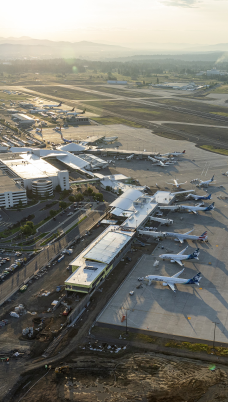
Twenty-year Master Plan Update
Spokane International Airport
Introduction
In September of 2000, the Spokane Airport Board began creating the Master Plan for the Spokane International Airport specifically to:
  • Develop a 20-year forecast of aviation activity
  • Determine the projected needs of the runway, taxiway system, air cargo and general aviation areas (airside), and the terminal building, parking and other facilities (landside).
  • Evaluate alternative development scenarios for each airport function (airfield, terminal area, air cargo, access and parking, airport support area and general aviation).
  • Prepare Airport Layout Plan (ALP) drawings.
  • Evaluate the airport's rates and charges to assure that the Airport Board is obtaining fair market value for its facilities, thereby remaining in compliance with Federal regulations and optimizing its ability to implement plan recommendations.
  • Assure that adequate opportunities for input are provided to airport users, the Airport
    Board, FAA, and the general public.
The Master Plan process is designed to assure that the general public is given adequate opportunity to understand the study's findings, question the individuals preparing the plans, and comment on the direction of the plan, as well as having a chance to influence the outcome. The primary vehicle for this step is represented in the Public Workshop process. The Planning team held public workshops on January 4 and July 24, 2001 to inform the public and collect their ideas about Spokane International Airport's future. During those meetings the comments recorded indicated that, overall, the community supported the Airport Board's efforts to upgrade the facility, keep up with the community's needs, provide for increased travel choices and stimulate economic development.The third and final public workshop is scheduled from 4:30 - 7:00 p.m., on Monday, September 17, 2001 at the Doubletree Hotel - Spokane City Center.
At the same time, the airport's residential neighbors were interested in how recommendations being made would impact their daily lives in terms of noise, overflights, increased surface traffic, etc. The following information was prepared with these comments in mind. We are anxious to hear your opinions and answer your questions.

How will activity at the Airport change over the next twenty years?

Passenger Projections
Passenger activity at the Spokane International Airport was forecast considering historical passenger levels, improvements being considered at other regional airports, national passenger growth trends, and other factors. Over the 20-year period covered by the master plan, it is expected that enplaned passenger levels will nearly double. As shown in the graph, passengers using the airlines will grow from today's level of 1.7 million per year to 3.3 million by 2020.

Air Cargo Projections
Growth in air cargo at Spokane International has been even more dramatic than the passenger level increases. Over the past five years the activity levels have doubled and even more dramatic increases are expected in the future. These are also shown in the graph.

Aircraft Operations Projections
Aircraft operations, or the number of takeoffs and landings, include air carriers, air cargo operations, general aviation and military flights. For the future, it is expected that overall operations will not increase at the same rate as passenger and freight volumes. Rather, the airlines, air cargo carriers and general aviation users are expected to use larger capacity aircraft. This change will be seen primarily in the regional carriers that will increase the number of regional jets. Air cargo carriers are expected to employ more MD-11 and Boeing 757 size aircraft, and general aviation will increasingly see larger private aircraft such as the Boeing GA jets, the Gulfstream V, or other business jets.

What development is being recommended for the Airport?

Each of the following improvements were recommended after thorough examination of the impacts (both positive and negative) they would have on the community. The resulting plan will expand Spokane's travel choices, increase economic activity and allow the airport to continue to serve as a vital piece of the area's transportation network. Please be assured detailed technical analyses will be needed before any of these major improvements are constructed, providing further opportunity for public input.

Airfield Improvements

  • Extend Runway 3-21 to 12,000 feet to accommodate air cargo aircraft.
  • Construct a new 13,000 by 150 feet runway to the west of Runway 3-21.
  • Relocate Taxiway "G" to 600 feet for safety under low visibility conditions.
  • Complete the parallel and access taxiway system to allow for operational efficiency.
  • Relocate the Aircraft Rescue and Fire Fighting Building in conjunction with the development of a third runway.
  • Relocate the Airport Traffic Control Tower.
  • Install and upgrade all navigational aids (Navaids).
  • Construct parking aprons for general aviation and air cargo aircraft.

For enhanced view click Airfield.pdf (Acrobat reader required)


Terminal Improvements

  • Add approximately 12 new aircraft gates to enhance competition through expansion of Concourse C. Include expansion of all related terminal activities (e.g. ticket counters, baggage claim, and others).
  • Expand the Air Carrier Apron to allow for additional aircraft parking.
  • Expand the automobile parking facilities (either garage or surface).
  • Improve the surface access system to increase safety and eliminate congestion.
  • Improve intersections through grade-separation, signalization or other methods.
  • Provide for potential development of light rail or other mass transit access to the airport.
  • Improve capacity for commercial users (e.g. rental car companies, taxis, etc.).

For enhanced view click Terminal.pdf (Acrobat reader required)


Air Cargo Improvements

  • Move existing all-cargo carriers to the East Side of airfield.
  • Provide for apron, processing buildings, ground service areas, and access and parking facilities.
  • Develop total area in stages to match demand as it arises.
  • Reserve adjacent property to provide for support facilities.


For enhanced view click Cargo.pdf (Acrobat reader required)


General Aviation

  • Expand and consolidate facilities.
  • Provide for increased use by larger, high-performance general aviation aircraft.
  • Provide for all segments of GA including FBO facilities, heavy and light maintenance shops, and private aircraft owners.
  • Provide for increased flight training activity.
  • Increase capacity with new hangars and other facilities.
  • Assure safe and secure operations.

Other Recommendations

  • Conduct detailed Environmental Analyses prior to major facility construction.
  • Provide for new drainage system to control run-off and assure adequate treatment of industrial waste.
  • Assure that utility systems are expanded to match development.
  • Extend security fencing where necessary.
  • Land acquisition to allow for future expansion.

Balancing this positive result is a concern for the airport and its neighbors. Noise generated by aircraft in the year 2020 has been analyzed and should not produce levels beyond those experienced today. Naturally the extended runway will cause noise levels to increase in the areas along the new approach paths, and the new parallel runway will extend noise into areas that are currently unaffected. However, these levels will be minimal and the areas to be impacted are currently undeveloped. Further, air quality impacts may be felt due to the increased number of surface vehicles using the airport. These will be minimized through improvements made on the access roads and parking areas to allow for more efficient operation.
How can I make my thoughts known?
The Spokane Airport Board is committed to keeping the public informed and included in the Master Planning process.
Contact

Spokane International Airport
9000 W. Airport Dr., Suite 204
Spokane, WA. 99224

Administrative Offices (509) 455-6434

Back